Read aloud by your device’s built-in voice. Nothing is sent over the internet.
For researchers
Study design, methods, work packages, and opportunities for collaboration. Outputs will be added as they emerge.
Study at a glance
CARE-PAC is being developed through a three-year, National Institute for Health and Care Research-funded product development award running February 2026 – January 2029. It combines a structured co-production phase, iterative system development, and a multi-site randomised controlled trial, alongside parallel health-economic and implementation work streams designed to support real-world adoption.
Research questions
CARE-PAC addresses three principal questions:
- Does a co-produced digital remote monitoring and support system improve symptom burden, quality of life, and patterns of healthcare utilisation for people with life-limiting illness?
- Does the same system improve the experience and reduce the unmet needs of informal carers and patients?
- Is the system cost-effective and feasible to integrate into routine UK palliative and end-of-life care pathways?
Methods
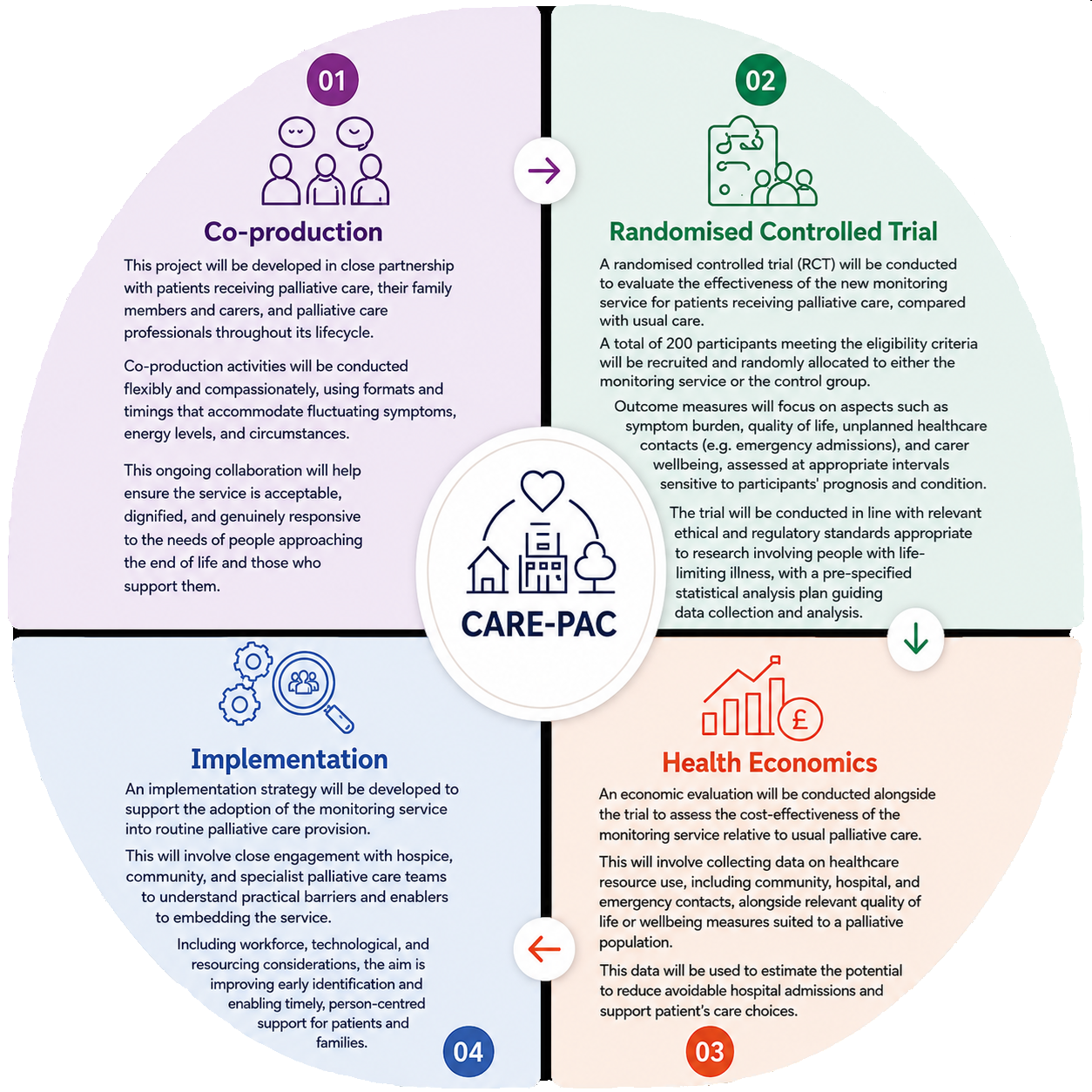
Open science commitments
- Trial pre-registration in a public registry (ISRCTN or equivalent) ahead of recruitment.
- Protocol and statistical analysis plan published prior to first analysis.
- Open-access publication of primary outputs where licensing permits.
- Plain-English summaries of every output, co-authored with our Lived Experience Group.
Working with us
We welcome collaboration with researchers in digital health, palliative care, health-services research, health economics, behavioural science, and implementation science. Specific opportunities include affiliated PhD and postdoctoral projects, secondary analyses, and methods exchange across cognate trials.
Want to be involved?
Whether you are a clinician interested in trial sites, a researcher exploring collaboration, or a patient or carer who would like a voice in shaping the system, we would love to hear from you.
Contact the team